
H-1B Visa Cap vs. Cap-Exempt: Everything You Should Know
Not all H-1B employers are subject to the annual cap. Learn the difference between cap-subject and cap-exempt jobs — and how it can expand your options.

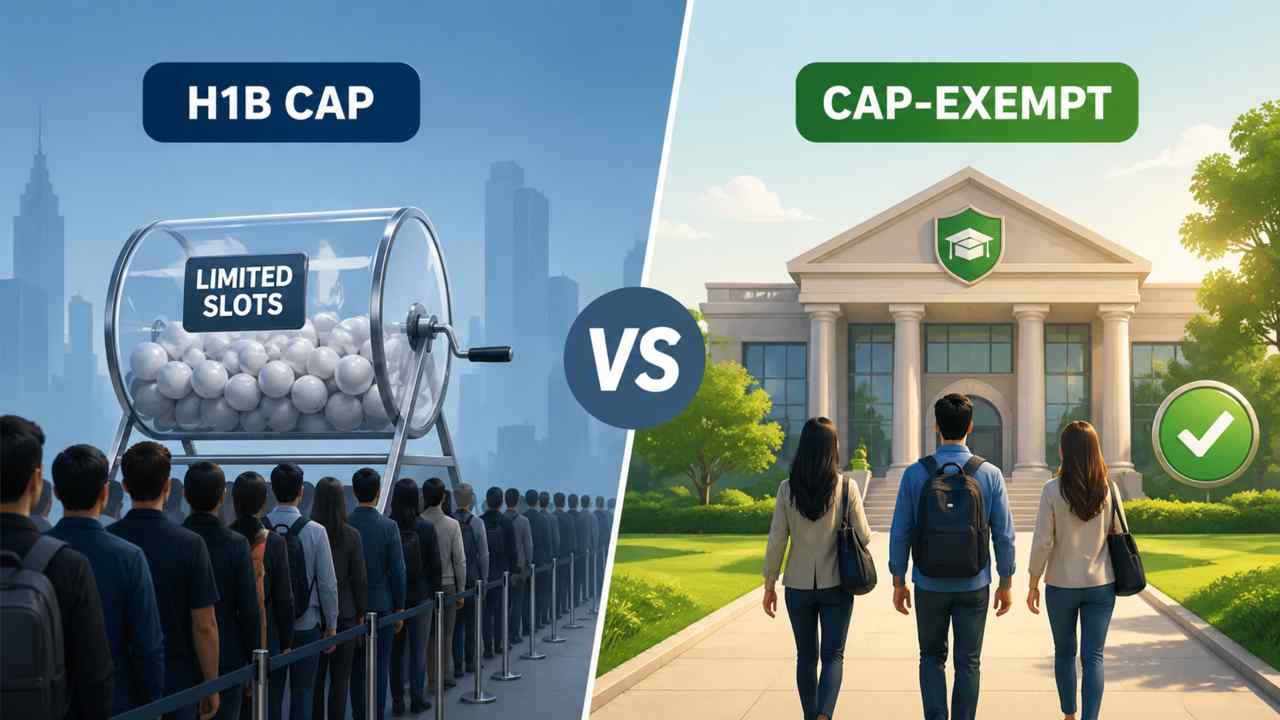
Each year, tens of thousands of international professionals compete for a limited number of H-1B visas. Most are funneled through the lottery system, hoping their employer-sponsored petition gets selected under the strict annual cap. But what many don’t realize is — not all H-1B jobs require you to go through the cap or the lottery at all.
There are two broad categories when it comes to H-1B petitions: cap-subject and cap-exempt. Cap-subject roles fall under the annual quota and must be selected in the USCIS lottery before an application can proceed. On the other hand, cap-exempt roles are not limited by this quota and can be filed at any time of the year — making them incredibly valuable for applicants and employers alike.
If you're a student on OPT, a researcher, or a professional in healthcare or education, you may qualify for cap-exempt H-1B sponsorship without even realizing it. These roles offer a faster path to work authorization and bypass the uncertainties of the lottery system entirely.
In this article, we’ll break down the difference between cap-subject and cap-exempt H-1Bs, who qualifies for each, how to find exempt employers, and what it means for your career planning and visa strategy.
What Is the H-1B Cap?
The H-1B cap refers to the annual limit on the number of new H-1B visas the U.S. government issues each fiscal year. Currently, the cap is set at:
65,000 regular H-1B visas (for most applicants)
20,000 additional visas for those with a U.S. master’s degree or higher (called the advanced degree exemption)
This means a total of 85,000 new H-1B visas are available each year — but demand far exceeds that number. In recent years, over 400,000 registrations have been submitted for those 85,000 spots, leading to the need for a random lottery system.
Why Does the Cap Exist?
The cap was designed to balance U.S. labor market protection with high-skilled immigration. It ensures that only a limited number of foreign professionals are admitted on H-1B visas each year, despite the consistently high demand from U.S. companies — especially in tech, engineering, and healthcare.
When Does It Apply?
The cap applies only to new H-1B filings under private (for-profit) employers. These filings are submitted once per year, typically during a registration period in March, for positions starting on October 1st.
If you are subject to the cap, you must be selected in the lottery first — otherwise, your petition cannot even be filed with USCIS.
What Is Cap-Exempt H-1B?
A cap-exempt H-1B is an H-1B visa petition that is not subject to the annual cap or the lottery. This means the employer can file your H-1B petition at any time of the year, and it doesn't have to compete for one of the limited 85,000 spots.
Cap-exempt petitions are typically tied to specific types of employers — not job titles or individuals. If the employer meets USCIS criteria for exemption, then every H-1B petition they file is automatically considered cap-exempt, regardless of when it's submitted.
Why Does This Matter?
For many professionals — especially those who miss the lottery or need to start working quickly — a cap-exempt H-1B is a golden opportunity. You avoid the uncertainty of the random draw, don't have to wait until October 1st to start working, and can often benefit from faster USCIS processing times.
This path is especially common for researchers, professors, doctors, and others working in higher education, non-profits, or research organizations.
Who Qualifies as a Cap-Exempt Employer?
Not all employers can bypass the H-1B cap — only those that fall into specific categories recognized by USCIS. If you're seeking a cap-exempt H-1B opportunity, it’s critical to know which employers qualify and how they’re defined.
Below are the main types of cap-exempt employers:
1. Institutions of Higher Education
These include:
Public or private universities and colleges.
Accredited institutions offering post-secondary degrees.
Example: Working as a research assistant at NYU, or a software engineer directly hired by Stanford University.
2. Non-Profit Organizations Affiliated with a University
To qualify, the nonprofit must:
Be closely affiliated with a higher education institution through shared control or operations.
Have a formal connection (such as training hospitals affiliated with med schools).
Example: A non-profit hospital directly tied to Harvard Medical School
3. Non-Profit Research Organizations
Organizations primarily focused on research and development in science, technology, or education. They don’t need to be tied to a university but must be designated as nonprofit.
Example: Working at a government-funded R&D lab like SRI International.
4. Government Research Organizations
This includes federal, state, or local agencies primarily engaged in research.
Example: A software developer at a U.S. Department of Energy research center.
Cap-exempt status is based on the employer — not the role title — so even IT, admin, or marketing positions can qualify if the employer meets USCIS exemption criteria.
Benefits of Cap-Exempt H-1B Sponsorship
Working with a cap-exempt employer comes with several major advantages, especially for international professionals trying to secure U.S. work authorization outside the limited H-1B lottery.
1. No Lottery Involved
You don’t need to compete for one of the 85,000 spots or rely on a random selection. If your petition is complete and approvable, you’re in — no waiting on a draw.
2. File Any Time of the Year
Cap-subject H-1B petitions must be filed in March and begin no earlier than October 1st. Cap-exempt employers, however, can file year-round, giving you the flexibility to start work much sooner.
3. Faster Hiring & Onboarding
Because there’s no seasonal deadline, cap-exempt roles typically allow for faster processing, onboarding, and less legal bottlenecking compared to the cap-subject route.
4. Great for OPT Students and Academics
F-1 students on OPT can move seamlessly into cap-exempt H-1Bs if they’re hired by a university or non-profit. Many STEM graduates use this strategy to avoid the cap and start work immediately.
These benefits make cap-exempt H-1B jobs an excellent strategy for those who missed the lottery, need faster sponsorship, or plan to stay in the U.S. long-term while building toward a green card.
Real-World Examples: Cap vs Cap-Exempt Jobs
To make the cap vs. cap-exempt distinction easier to understand, here are real-life scenarios that show how different employers and job offers are treated under H-1B rules:
Job Scenario | Cap Subject? | Cap-Exempt? |
Software Developer at Google (private tech company) | ✅ Yes | ❌ No |
Assistant Professor at a U.S. university | ❌ No | ✅ Yes |
Research Scientist at a nonprofit medical institute | ❌ No | ✅ Yes |
IT Support at a university-affiliated hospital | ❌ No | ✅ Yes Global BriefingGet the week's most critical immigration news and policy analysis directly in your inbox. |
Marketing Analyst at a public school system | ✅ Yes | ❌ No |
Data Analyst at a government R&D lab | ❌ No | ✅ Yes |
Hired by a private consulting firm (non-exempt) | ✅ Yes | ❌ No |
💡 Key Notes:
The employer’s status, not the job title, determines exemption.
You can be in a non-tech or non-academic role and still qualify for cap-exemption if the employer meets USCIS criteria.
Proof of affiliation is essential in borderline cases (like university hospitals or nonprofits connected to schools).
Cap-Exempt to Cap-Subject: Can You Switch?
Yes, you can switch from a cap-exempt H-1B job to a cap-subject employer — but you’ll need to go through the lottery if you haven't already been counted against the cap.
This is an important consideration for those who start their careers at a university or nonprofit and later want to transition to a private-sector company like Amazon, Deloitte, or Tesla.
How the Transition Works
If your current H-1B is cap-exempt and you haven’t been counted in the lottery before:
→ Your new employer must register you for the next cap-subject H-1B lottery.
→ If selected, they can then file a new H-1B petition on your behalf.If you were already counted in the cap (e.g., in a previous private job):
→ You may transfer to another cap-subject employer without going through the lottery again.
What to Watch Out For
You cannot begin working for a cap-subject employer unless you're selected in the lottery (unless previously counted).
Planning is crucial — coordinate with both employers and time the switch during the lottery season (typically March).
If you leave your cap-exempt job before your new cap-subject H-1B is approved, you may fall out of status.
This is why some professionals stay in cap-exempt roles long-term — for job security, continuous work authorization, and year-round flexibility.
Common Misconceptions About Cap-Exempt H-1Bs
Cap-exempt H-1Bs are often misunderstood — both by applicants and even some employers. Believing myths about this visa path can lead to poor planning, delayed filings, or even denial. Let’s clear up a few common misconceptions:
1. “Once You’re Cap-Exempt, You're Always Exempt”
Not true. Cap-exempt status only applies while you're working for a cap-exempt employer. If you switch to a cap-subject job (like a private tech company), you’ll need to enter the H-1B lottery unless you've already been counted under the cap.
2. “Cap-Exempt Means You Can Work for Any Employer”
Only the cap-exempt employer can sponsor you outside the cap. You can't take side gigs or consulting jobs for cap-subject companies without separate authorization.
3. “All Nonprofits Are Automatically Cap-Exempt”
Incorrect. Only nonprofits affiliated with universities or qualified research institutions qualify. A random NGO or small charity won’t make you exempt unless it meets specific USCIS criteria.
4. “Cap-Exempt Petitions Are Less Strict”
The paperwork and legal requirements are just as serious as any H-1B petition. You still need to meet qualifications, follow wage laws, and comply with USCIS procedures.
Understanding these details will help you avoid costly mistakes — and better evaluate job offers based on your long-term visa goals.
How to Find Cap-Exempt Employers
If you're looking to avoid the H-1B lottery or need urgent work authorization, targeting cap-exempt employers can be a smart strategy. But how do you find them?
Here are some effective ways to identify and apply to cap-exempt opportunities:
1. Target Universities and Colleges
Most accredited U.S. universities are cap-exempt. Look for:
Faculty and research positions.
Administrative or IT roles on campus.
University-affiliated hospitals and clinics.
📌 Tip: Check the HR/careers page of universities in your field or location of interest.
2. Explore Research Institutions & Nonprofits
Look into:
Medical research centers.
Think tanks.
Nonprofit laboratories (especially those tied to universities).
Make sure the organization is formally affiliated with an institution of higher education or qualifies under the USCIS nonprofit research exemption.
3. Use USCIS H-1B Disclosure Data
Every year, USCIS publishes a list of employers who have filed H-1Bs — both cap-subject and cap-exempt. Use this to:
Identify trends in cap-exempt filings.
See what types of roles they’ve sponsored.
Narrow down employers by location and industry.
🔗 (You can internally link to a guide or resource page you create later: “Where to Find H-1B Sponsors by Industry”).
4. Use Keywords When Job Hunting
On job boards like LinkedIn, Indeed, or HigherEdJobs.com, search using:
“H-1B sponsorship” + “cap-exempt”
“University-affiliated”
“Nonprofit research”
You can also reach out to recruiters directly and ask about cap-exempt eligibility before applying.
Conclusion
Understanding the difference between cap-subject and cap-exempt H-1B employers can drastically change your U.S. work visa strategy. While most applicants compete for limited lottery slots under the cap, cap-exempt opportunities offer a faster, more flexible path — especially for those in education, research, or nonprofit sectors.
If you missed the H-1B lottery or want to avoid it altogether, don’t lose hope. Cap-exempt employers can file your petition year-round without the lottery restriction, giving you an edge in timing and job security. The key is knowing where to look, who qualifies, and how to navigate the rules.