
H4 Visa for Dependents: How Your Spouse and Kids Can Stay in the U.S
If you're in the U.S. on an H1B visa and want your family to join or stay with you, the H4 visa is the official dependent visa for spouses and children. This guide explains how the H4 works, who qualifies, how to apply, and how your spouse might even be eligible to work.


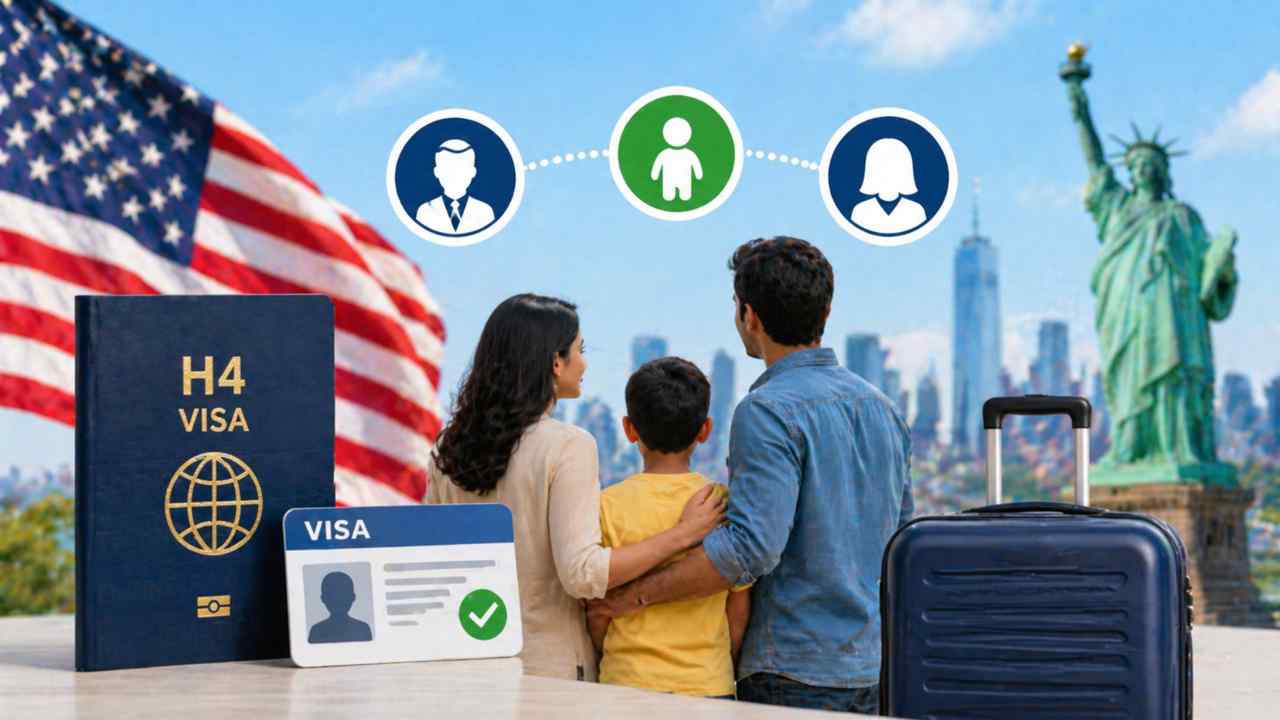
If you're in the U.S. on an H1B visa and want your family to join or stay with you, the H4 visa is the official dependent visa for spouses and children. This guide explains how the H4 works, who qualifies, how to apply, and how your spouse might even be eligible to work.
Many H1B workers in the U.S. want their families close by — to build a life, raise children, or simply enjoy everyday support. Fortunately, the U.S. immigration system allows for dependents to accompany H1B visa holders through the H4 visa category. This visa is specifically designed for spouses and unmarried children under the age of 21, giving them legal status to live — and in some cases, work — in the U.S.
While the H4 visa may seem straightforward at first, it comes with its own processes, limitations, and special considerations — especially when it comes to travel, work eligibility, and visa renewals. Understanding these rules upfront can help avoid unnecessary delays or risks to your family’s immigration status.
In this guide, we'll walk you through everything you need to know about the H4 visa — from who qualifies and how to apply, to what happens when your H1B status changes or when your spouse becomes eligible for a work permit under the H4 EAD.
What Is the H4 Visa?
The H4 visa is a U.S. visa specifically designated for the dependent family members of H1B visa holders. It allows your spouse and children (under the age of 21) to legally stay in the United States with you while you work under H1B status. The H4 is a non-immigrant visa, and its validity is entirely tied to the primary H1B visa holder’s status.
In other words, if your H1B visa is valid for three years, the H4 visa for your dependents will generally match that timeline. Similarly, if your H1B status ends or is revoked, the H4 dependents lose their legal status as well — unless they change to a different visa type.
While H4 holders are not automatically allowed to work, they can attend school, apply for a driver’s license, and live in the U.S. without restrictions. In some cases — particularly if the H1B spouse has reached a certain stage in the green card process — the H4 spouse can apply for work authorization (H4 EAD), which we’ll cover later in this article.
Who Qualifies as a Dependent?
To be eligible for an H4 visa, you must be a dependent of a valid H1B visa holder — but U.S. immigration law clearly defines who counts as a dependent in this context. Only immediate family members are eligible, and this includes:
The legal spouse of the H1B visa holder (must be legally married)
Unmarried children under the age of 21
That means partners in common-law marriages, domestic partners, or fiancés are not eligible for H4 status. Similarly, children who are over 21, even if financially dependent, do not qualify under H4 once they “age out.” They may need to switch to a student visa (like F1) or another appropriate status.
Other family members such as parents, siblings, or in-laws are not eligible for an H4 visa either, regardless of their financial or emotional dependence on the H1B worker.
It’s also worth noting that H4 dependents must maintain their own valid status, just like the H1B worker — and this includes making timely extensions, responding to USCIS requests, and complying with travel and I-94 rules.
How to Apply for an H4 Visa (Outside the U.S.)
If your spouse or children are outside the United States, they’ll need to apply for an H4 visa at a U.S. embassy or consulate abroad before they can join you. The process is generally straightforward but requires careful documentation and preparation for the visa interview.
Step-by-Step Application Process
Complete the DS-160 Form
Each H4 applicant must fill out the DS-160 (Online Nonimmigrant Visa Application). After submission, they’ll receive a confirmation page with a barcode — this is needed for the visa interview.Pay the Visa Fee
The visa application fee (currently around $185) must be paid before scheduling the interview. Payment procedures vary slightly by country.Schedule the Visa Interview
Once the DS-160 is complete and the fee is paid, you can schedule an appointment at the nearest U.S. embassy or consulate. In some countries, children under 14 may be eligible for an interview waiver (dropbox option).Prepare Required Documents
Typical documents include:Valid passport(s)
DS-160 confirmation
Visa fee receipt
H1B spouse’s I-797 approval notice
H1B spouse’s employment verification letter
Marriage certificate (for spouse) or birth certificates (for children)
Photos per U.S. visa specifications
Attend the Interview
At the appointment, a consular officer may ask about your relationship to the H1B visa holder, your intention to live in the U.S., and financial or personal ties.
Once approved, the passport is stamped with the H4 visa and returned to the applicant. Upon arrival in the U.S., they will receive an I-94 record, which defines their legal stay duration.
H4 Visa Filing Process Within the U.S. (Change of Status)
If your spouse or children are already in the U.S. on another valid visa — such as B1/B2 (visitor), F1 (student), or even on a different dependent status — they can apply for a change of status to H4 without leaving the country. This is done through a petition to USCIS using Form I-539.
How to File a Change of Status to H4
Complete Form I-539
This form is used by dependents to request a change or extension of nonimmigrant status. Each dependent can be listed on the same form if filed together as a family.Include Supporting Documents
Current I-94 records for each applicant
Proof of relationship to the H1B visa holder (marriage/birth certificates)
A copy of the H1B worker’s I-797 approval notice, passport, and latest I-94
Employment verification letter and recent pay stubs of the H1B holder
Pay the Filing Fee
As of 2025, the fee is approximately $470–$620 per applicant, depending on biometrics and method of filing.Biometrics Appointment
USCIS typically schedules a biometrics appointment (fingerprinting and photo) after submission.Wait for Approval
Processing times can vary — usually 2 to 6 months. During this time, applicants must maintain valid status in the U.S. until the change is approved.
If the primary H1B petition is also under processing (such as for an extension or change of employer), USCIS may issue an RFE requesting both applications be approved together — often called a bridge petition.
Changing to H4 from within the U.S. is convenient but comes with the downside of no international travel allowed while the change of status is pending. If travel is necessary, it’s often better to apply for the H4 visa abroad.
H4 Visa Duration and Renewal
The duration of an H4 visa is directly tied to the validity of the primary H1B holder’s status. If your spouse’s H1B is approved for three years, your H4 status will match that period. Similarly, when the H1B is extended, your H4 must also be extended to remain in legal status.
When and How to Renew the H4 Visa
If you are inside the U.S., your employer or attorney can file the H4 extension concurrently with the H1B extension using Form I-539. This ensures your status is maintained continuously. It’s important to file before your current I-94 expires to avoid falling out of status.
If you're outside the U.S. when your H4 is expiring or already expired, you must reapply for the H4 visa at a U.S. consulate using your spouse’s new I-797 approval notice. After visa stamping, you can return and receive a new I-94 upon entry.
Global Briefing
Get the week's most critical immigration news and policy analysis directly in your inbox.
Travel While H4 Is Pending
If you leave the U.S. while an H4 change of status or extension of status is pending, that application is considered abandoned. In such cases, it’s better to re-enter with a stamped H4 visa abroad rather than wait for USCIS approval.
For those with approved H1B extensions but pending H4 extensions, premium processing does not speed up I-539 filings. However, USCIS has started bundling H1B and H4 petitions in some cases, leading to faster decisions — though this is not guaranteed.
Can H4 Dependents Work in the U.S.? (H4 EAD)
While most H4 visa holders are not automatically eligible to work, certain H4 spouses can apply for an Employment Authorization Document (EAD) and legally work anywhere in the U.S. — full-time, part-time, or even start a business.
This is a major benefit for families where both partners want to maintain their careers while living in the U.S.
Who Is Eligible for H4 EAD?
To qualify, the H1B visa holder must meet one of the following conditions:
They have an approved I-140 immigrant petition (employment-based green card stage), or
They are in H1B extensions beyond the 6-year limit under the AC21 Act because the green card process is underway.
Only H4 spouses are eligible — not children.
How to Apply for H4 EAD
Eligible H4 spouses must file Form I-765 with:
Proof of H4 status (I-94, visa stamp)
Marriage certificate
H1B’s I-140 approval or evidence of qualifying extension
Two passport-style photos
Filing fee (around $470 as of 2025)
Once approved, the H4 spouse receives an EAD card, which allows unrestricted work authorization. The EAD must be renewed before expiration, and employment cannot continue during a lapse.
Processing Times and Tips
Processing times typically range from 2 to 6 months, though USCIS occasionally offers bundled processing when filed with H1B extensions. Premium processing does not apply directly to H4 EADs, but an approved H1B extension can help move the overall case forward.
H4 Visa Travel and Re-entry
H4 visa holders are allowed to travel internationally and re-enter the U.S. as long as they maintain valid visa status. However, it's essential to prepare the right documents and understand what to expect at the port of entry — especially if the primary H1B visa holder’s situation has recently changed.
Documents Required for Re-entry
To re-enter the U.S. after international travel, H4 dependents should carry:
A valid H4 visa stamp in their passport
A valid passport (at least 6 months beyond the intended stay)
The primary H1B holder’s I-797 approval notice
A copy of the H1B spouse’s recent pay stubs and employment verification letter
Marriage or birth certificates (to prove dependent relationship, if requested)
At the Port of Entry
Upon arrival in the U.S., H4 dependents will be issued a new I-94 record, which determines their stay duration. Make sure to verify that the I-94 expiration matches the H1B spouse’s end date, not the visa stamp, which may have a different validity period.
If the H1B visa was recently extended but the H4 visa stamp was not updated, dependents may need to get a new visa stamp abroad to reflect the latest I-797 approval before re-entering.
Schooling for H4 Children
H4 children can attend public or private school in the U.S. without needing an F1 student visa. They may also travel internationally and return, as long as they have a valid H4 stamp and the necessary documents listed above.
H4 to Other Visa Types or Green Card
While the H4 visa is ideal for staying with a family member on H1B, many dependents eventually explore transitioning to a different visa or adjusting status for permanent residency (green card). These transitions are common for both spouses seeking independent work visas and children who age out of H4 eligibility.
Switching from H4 to Another Visa
If the H4 spouse or child becomes eligible for a visa like F1 (student), H1B (work), or even L1 (intra-company transfer), they can apply for a change of status within the U.S. or at a U.S. consulate abroad.
Examples:
An H4 spouse gets a job offer and applies for a cap-subject H1B visa through the lottery
An H4 child turns 21 and switches to F1 student status to remain legally in the U.S.
In all cases, a proper visa petition or application must be filed and approved before working or attending school full-time (if changing to F1).
Green Card Options for H4 Dependents
H4 dependents are eligible to apply for green cards as derivative beneficiaries when the H1B worker sponsors the family through an employment-based petition (typically EB2 or EB3 categories). Once the H1B worker’s I-140 is approved and a visa number is available (per the Visa Bulletin), the H4 dependents can file Form I-485 (Adjustment of Status) alongside the primary applicant.
During this phase, H4 dependents are also eligible for advance parole (travel permit) and employment authorization (EAD) while their green card is pending.
This makes the green card process a practical and long-term solution for H1B families planning to settle in the U.S.
Conclusion: Keeping Your Family Together on an H1B
The H4 visa allows your spouse and children to live with you in the U.S. while you're on an H1B — offering peace of mind, family support, and even the possibility of employment through the H4 EAD. Whether you're bringing your family from abroad or adjusting their status from within the U.S., it’s essential to follow the right process and maintain legal status for everyone involved.
Understanding the rules around travel, renewal, and work eligibility will help you avoid delays and keep your family together throughout your immigration journey.
Related Articles You May Find Helpful
H4 EAD Process: How to Apply for a Work Permit as an H4 Spouse
Documents Needed for H1B Filing: Checklist for Employees and Employers
H1B to Green Card: EB2 and EB3 Paths Explained
H1B Visa Stamping Process: What to Expect at the U.S. Embassy